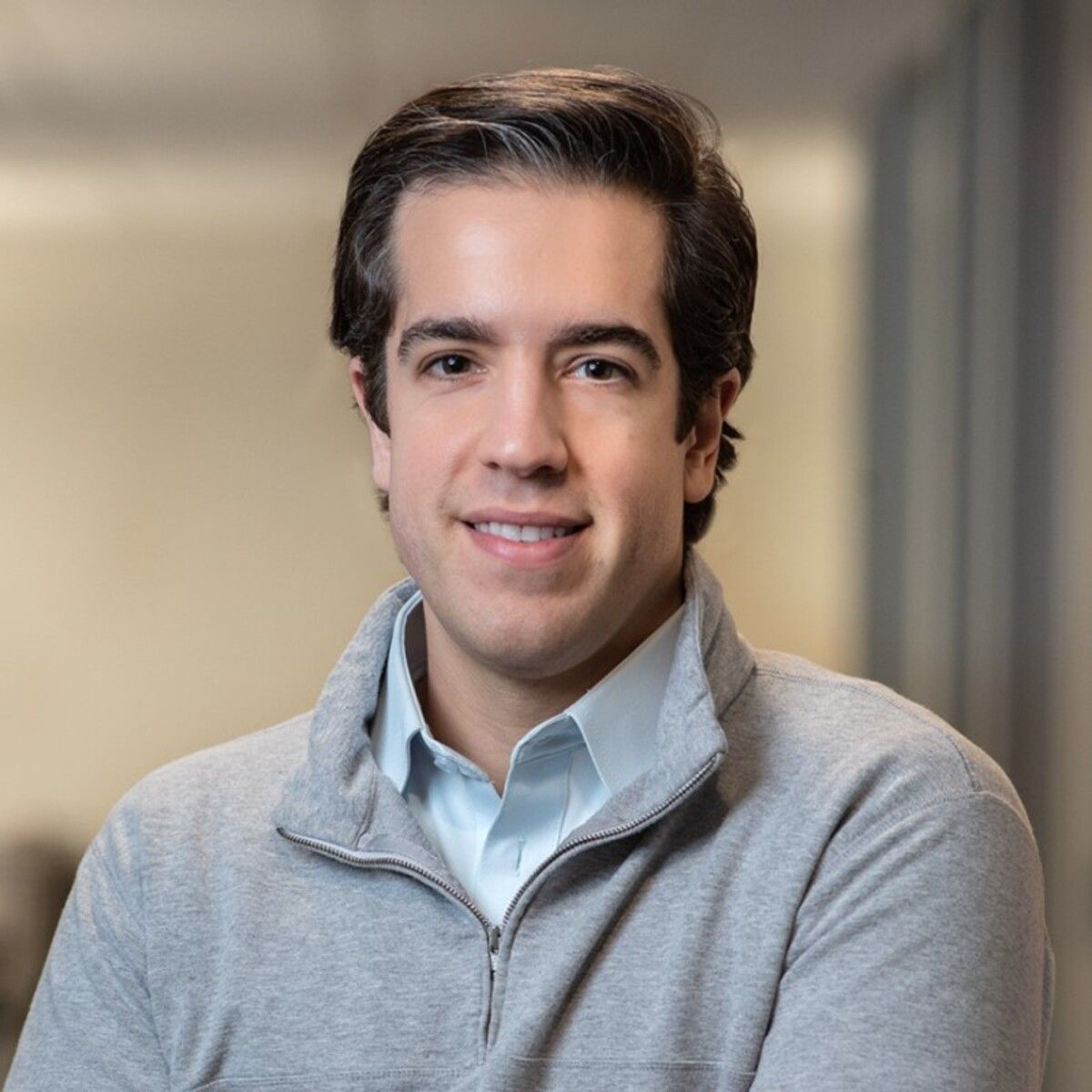

New episode on the Crew Podcast - Nick Bogaty, CRO @ Vercel.
Also, shoutout to our sponsors for this episode, Parallel & Attention. Been awesome working with both of these teams for recruiting, and now infusing as part of our media arm. Both incredible products used by a bunch of the AI-natives we work with.

Parallel: Where AI agents find answers - a web index built from the ground up for AI. GTM engineers use it to run real-time account monitors (funding rounds, exec changes, product launches) and automate research and enrichment at scale. Get started for free @ https://parallel.ai/
Attention: Put a team of revenue agents on every deal. They capture all your customer interactions (without a bot), update your CRM, best engage on your deals, cleanly automate all reporting, score opportunities and reps against any framework, and forecast in a way you can actually trust. The fast-growing companies like Lovable, Avoca, Abridge, and hundreds of others rely on them. Try them today here.
Some of our previous guests:
Eleanor Dorfman, Head of Commercial Sales @ Anthropic, see here
Pat Forquer, CRO @ Legora, see here
Graham Moreno, VP of GTM @ Parallel, see here
Tomer Chernia, VP of GTM @ Cursor, see here
Liam Mulcahy, Head of Sales @ Parallel (former GTM Operating Partner @ Kleiner Perkins)
Becca Lindquist, Head of Sales @ Clay
Kyle Parrish, former VP of Sales @ Figma
Ghazi Masood, CRO @ Replit
Evan Cassidy, VP of Sales @ Decagon
James White, VP of Sales @ Rogo
Mark Ebert, SVP of Revenue @ Profound
Rob Saliterman, VP of Sales @ Harvey
Bardia Shahali, VP of Sales @ Granola
And many more in the pipeline - if you know any good leaders who fit this, shoot me a DM/reply/email ( [email protected] ). We’ll keep openings rolling and be super open to suggestions for similar guests.
We film in-person in SF & NYC at legit podcast studios and have retained a stellar post-production agency, so the quality will be high.

behind the scenes filming our episode with Graham Moreno, VP of GTM @ Parallel, back in May 2026
Links To Sections

Nick’s Background
Nick Bogaty is the CRO at Vercel, about six months into the seat, and he has one of the most non-linear paths to revenue leadership you'll hear.
He spent 10 years running open source projects, including building the file format standard for electronic books (the reason your Kindle works the way it does). From there he ran product teams at Adobe, joining when the company was around 4,000 employees. He always had a commercial mindset and was closing deals along the way, just never officially in a sales role.
He then moved to AppDynamics alongside a few Adobe folks as the company prepped to go public, taking over the post-sales organization. After the Cisco acquisition, he was tapped to run all of go-to-market. That made CRO of AppDynamics his first official sales job, and during his run the business grew from roughly $120M to $700M in revenue.
After another CRO seat and a long return stint at Adobe, he wanted back into the middle of the two questions he cares most about: how people will design in the future, and how people will build in the future. Vercel happens to be answering both.
Discussed In This Episode
How a product guy's first sales job ended up being CRO of AppDynamics
The SKO moment with Jeremy Duggan and Tom Levy that made him fall in love with sales
The value pyramid: why AppD reps knew the customer's business better than the customer did
How the 4th best product in the market still grew $120M to $700M
The weekly operational cadence: leading indicators, compounding gains, and two customer meetings a day
Hiring: was the person successful, or was the company? And why he wants artifacts, not answers
Why you should test candidates hard in the first interview, even the passive ones
Weekend warriors: what happens when CTOs build pet projects on your platform and LLMs recommend you as the place to deploy
Athena: the internal GTM product Vercel's sales team runs on every day
Consumption vs. commitments, and the bifurcation between SaaS and infrastructure buying
Interesting Takeaways
1. His First Official Sales Job Was CRO of AppDynamics
Nick's career was firmly non-linear: a decade running open source projects, then product teams at Adobe, always closing deals but never carrying the title. He joined AppD to fix post-sales ("we had a very good sales organization, not a great post-sales organization").
Then the Cisco acquisition changed what the company needed. Growth was slowing, the market was maturing, and leadership bet that his product and customer background would serve the sales team better than a traditional net-new closer. Credit to the teachers: Jeremy Duggan and Tom Levy let him sit in their sales leadership meetings, and leaders like Phil Cody (now Chainguard) and Jake Yount (Abnormal) taught him the daily mechanics.
2. The SKO That Changed His Career
His mental model of salespeople was "largely relationship oriented people." Then came his first AppD SKO: "for the first time ever in my life, I saw a sales team scientifically approach a market." Reps trained to know the customer's business better than the customer did. His reaction: "I want to learn the craft."
The engine was the value pyramid. Most teams run "us, us, us... oh by the way, you." AppD flipped it: company, company, company... and then finally AppDynamics. It worked so well that economic buyers would ask "how do you know all this information?" Almost "do you have a mole in my company?" How he hires for it: hand candidates a business case and have them research it and walk you through it, a test for business sense.
3. How the 4th Best Product Grew From $120M to $700M
Refreshingly honest: early AppD had a real product edge, but as cloud observability took off, Datadog captured that wave, "much to our eventual demise." What AppD had instead was "the best enterprise go-to-market by far."
That's what took the business from ~$120M to $700M. His three reasons: they hired better than anyone else, they went deeper on the customer's business than any competitor, and "we did pipeline generation better than anybody."
4. The Whole Sales Team Goes to the Gym Every Week
Why AppD keeps getting named next to Mongo: a "relentless week over week process that everyone in the entire organization believed in." Compounding gains: run the same PG cadence every week, and after 30-50 weeks the whole team is stronger.
The leading indicators were simple: meetings with net-new customers and total meetings. His rule: "if you're a rep and you don't have two customer meetings a day, at least, something is wrong." Nobody cared about call or email volume, just whether you were in the market.
And the hardest part of learning sales wasn't the craft, it was the discipline: "you can be the smartest person in the room, but if you aren't disciplined... you don't have a predictable process."
5. Show Me the Receipts
Two hiring ponds: hypergrowth alumni (Snowflake, Datadog, AppD in their day) and unique people at companies that didn't hit the market right. Both valid, but for the first group you have to "really, really inspect their own personal contribution" versus the wave they rode.
His filter is specificity: "Anyone on the planet can say I build champions. Anyone on the planet can say MEDDIC. I want to see the goods." The messaging, the email, the research: "I'm a history major. I want to see the primary evidence." Best story of the episode: a BDR candidate claimed he was constantly meeting customers, so Nick said "show me your calendar." The last three weeks were empty.
His advice for hiring managers: test hard in the first interview. The best candidates want to be challenged, and the ones who tap out just told you everything. Even the passive stud from a safe logo gets his version of the Steve Jobs sugared-water line: "do you want to figure out how people are going to build in the future, or do you want your safe job?"
6. Weekend Warriors: When the Machines Recommend You
We're in a moment where anyone can build websites and agents on the weekend, not just developers. Nick thinks salespeople should be doing it constantly: "if they aren't, they're at a disadvantage in the market."
The buyers already are. CTOs and CIOs are opening personal Vercel accounts for weekend pet projects, and when anyone asks Claude Code or Codex where to deploy, the machine says Vercel. That's a whole new signal layer: "an extreme advantage... to triangulate an enterprise sales campaign on that data." The catch: those communities are sensitive, and you have to treat them with respect.
The motion: take that ground-up momentum straight to CIOs and CTOs. "There's this demand happening at your company, and that demand is there for a reason." And for anyone trying to get Vercel's attention: "It's not who you know. Build something and show it to us."
7. Athena: The Sales Team That Builds Its Own Software
Jeanne's line was "if you can map out a workflow, you can agent it." Nick's take six months in: true on one end. Inbound was agent-able (they built an agent and moved the team to outbound PG), but an enterprise sales campaign is "the extreme opposite end." Next up: value engineering agents that build the business case for reps.
The flex: all of Vercel's GTM tooling is built on Vercel. The internal product, Athena, covers territory planning, forecasting, pipeline generation, and consumption signals, and "literally every single salesperson is using that every day." My favorite line, from a guy whose first sales job was CRO: "I'm not a developer. It's been incredibly liberating to build that stuff."
Timestamps
(0:00) From product guy to CRO: Nick's non-linear path
(4:31) The AppDynamics SKO that converted him to sales
(6:53) The value pyramid: make it about their company, not yours
(10:48) The operational cadence behind $120M → $700M ARR
(12:16) Winning enterprise with the 4th-best product
(14:24) "Do you have a mole in my company?"
(17:20) The hardest part of sales: discipline
(18:04) Why Nick joined Vercel: how we'll design and build next
(21:03) Adobe's font team and why taste now wins
(24:24) Collapsing GTM headcount with AI agents
(26:50) Was it the rep, or the rocket ship?
(29:30) "Show me the receipts"
(33:42) Selling the mission to someone who isn't looking
(35:32) The coachability test in every first interview
(37:39) Weekend warriors and signal-based GTM
(39:23) Turning ground-up momentum into enterprise deals
(41:18) Usage vs. commitment in a consumption world
(43:56) The sales team Nick admires most: Datadog
(45:36) Building Athena: Vercel's homegrown GTM engine
(47:45) The most creative way to get a sales team's attention
Thanks for tuning in!
If you enjoy it, please give us a rating, review, or follow on Spotify/YouTube/Apple Podcasts - it really helps us grow this.
For those who are new, my name is Chris Balestras, co-founder & head of talent, media, & brand @ Crew - a GTM recruiting, media, and investing firm, working with seed through series D AI-natives to help them grow.
Where to find Crew:
We work with many of the hottest AI-native startups in various capacities, and for those who are interested, shoot me an email at ( [email protected] ) or a DM on LinkedIn.
🫡 cheers,
Chris